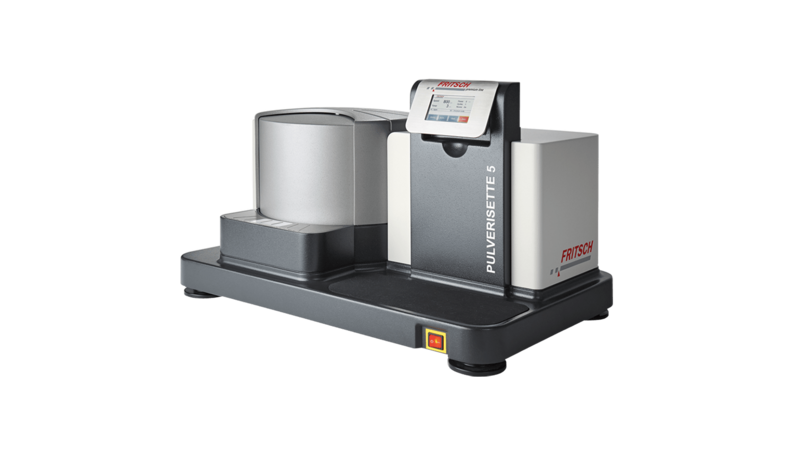
| Cihaz Türü | Gezegen (Planetary) Bilyalı Değirmen |
| Kullanım Amacı | Yüksek Enerjili Öğütme, Karıştırma ve Homojenleştirme |
| Uygulama Modu | Kuru Öğütme ve Islak Öğütme |
| Uygun Numune Tipleri | Sert, Orta Sert, Kırılgan ve Lifli Malzemeler |
| Maks. Besleme Tane Boyutu | 10 mm |
| Ulaşılabilen Son İncelik | < 1 µm |
| İstasyon Sayısı | 2 veya 4 |
| Toplam Numune Kapasitesi | 450–900 ml |
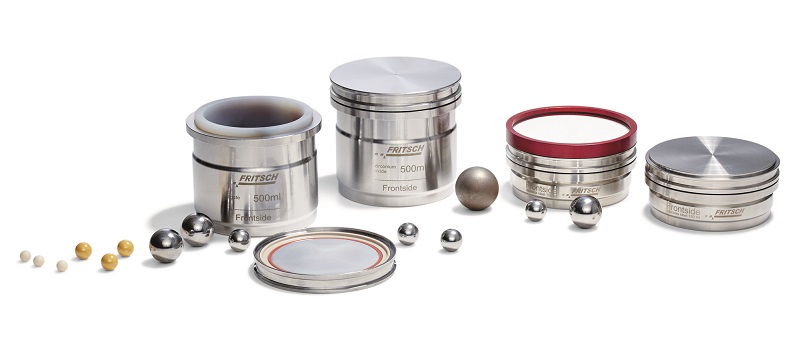
| Öğütme Kabı Hacimleri | 15–500 ml |
| Ana Disk Hızı | 50–800 rpm |
| Öğütme Kabı Maks. Hızı | 1600 rpm'ye kadar |
| Maks. Santrifüj İvmesi | 22–64 g |
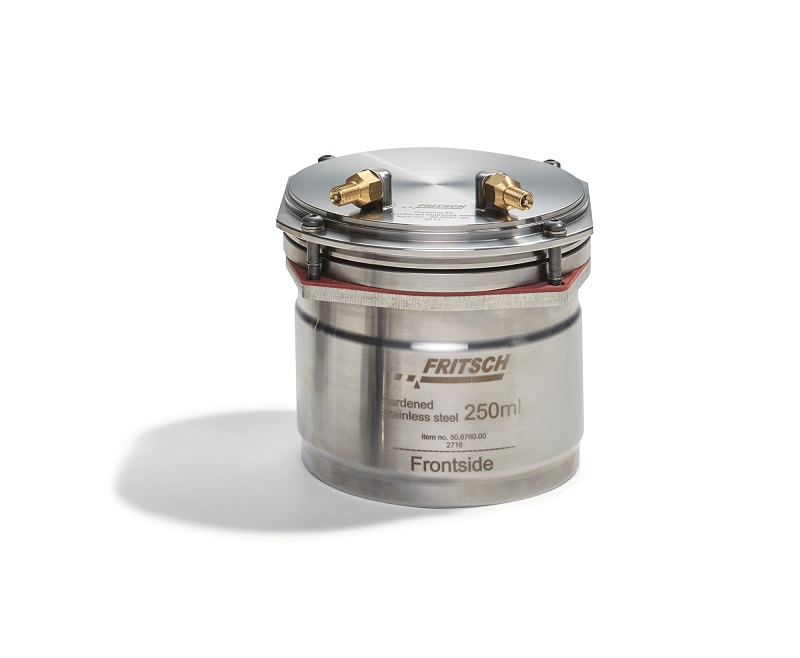
| Atmosfer Seçenekleri | İnert Gaz Altında Öğütme |
| İzleme Seçenekleri | Basınç ve Sıcaklık Takibi |
| Güvenlik Özellikleri | Kap Kilitleme Sistemi, Dengesizlikte Otomatik Durdurma |
| Operasyonel Kolaylık | Çalışma Parametrelerinin İzlenmesi |
| Kap ve Bilya Malzemeleri | Akik, Zirkonya, Paslanmaz Çelik, Tungsten Karbür |
| Bilya Çap Aralığı | 0.1–20 mm |
Metalurji, Seramik, Jeoloji/Mineraloji, Toz Metalurjisi, Kompozit ve Genel Numune Hazırlama
Sümran Bilgin, Bülent Öztürk, Furkan Alptekin, Sefa Emre Sünbül, Sultan Öztürk, Kürşat İçin
2025In this study, the phase structure formed during the mechanical alloying preparation of Ni-doped Co4Fe2Nix(Al1.5Mn1.5)3 (x = 0, 0.5, and 1.0) high-entropy alloys (HEAs) prepared via the mechanical alloying method was examined to investigate the relationship between the changes in phase structure and magnetic properties through hysteresis curves and FORC analysis. As a result of the mechanical alloying process, intense agglomeration of particles was observed, and the particle size was determined to vary between 2.36 and 5.57 µm. Contrary to the theoretically calculated phase structure, it was found that not only the BCC phase but also the FCC and Laves phases were formed in the structure after mechanical alloying. Contrary to these analyses, microstructural examinations revealed that the BCC phase, which has a regular structure, transformed into the D03 phase due to the rapid solidification effect. Additionally, regions rich in Al, Mn, and Co were identified in the microstructure. Magnetic measurements resulted in saturation magnetization (Ms) values of 113.0, 111.6, and 112.7 emu/g for Ni0, Ni0.5, and Ni1.0 samples, respectively; intrinsic coercivity (Hci) values were determined as 171.3, 168.9, and 171.4 Oe. FORC analysis indicated that Ni addition narrows vertical diffusion and partially facilitates domain wall movement; however, structural irregularities in some samples contributed to increased intrinsic coercivity and the presence of non-ferromagnetic phases.
Mertcan Kafali, Kadir Mert Doleker, Azmi Erdogan, Sefa Emre Sunbul, Kursat Icin, Ataberk Yildiz, Mustafa Sabri
2023High entropy alloys have promising wear, oxidation, and corrosion properties compared to conventional alloys and superalloys. In the present study, CrCuFeNiAl0.5 and CrCuFeNiAl0.5Si0.5 alloys were prepared using a traditional powder metallurgy process and then remelted the surfaces via laser. The laser remelting (LR) process gains a denser and more homogeneous surface to alloys. Pressureless consolidated and laser-remelted specimens were subjected to wear, corrosion, and oxidation tests. In the wear tests, it was observed that the wear resistance of Si-containing samples was better due to higher hardness. However, the laser remelting process has mostly increased rather than reduced wear losses. The less volume loss of laser-melted samples was attributed to the almost pure Cu in its content. There is little difference among all samples in electrochemical corrosion measurements. The formation of a fragile passivation layer was observed in potentiodynamic polarization curves of CrCuFeNiAl0.5Si0.5 and LR-CrCuFeNiAl0.5Si0.5 alloys. The alloy with the best corrosion resistance is CrCuFeNiAl0.5Si0.5, whose icorr value is 0.936 × 10⁻⁶ A/cm2. After high-temperature oxidation tests, the CrCuFeNiAl0.5 alloy exhibited the worst oxidation performance due to not forming a protective oxide layer on the surface, while LR enabled the protective oxide scale in a short oxidation time. The presence of Si in this alloy relatively enhances the oxidation resistance. The best oxidation performance was observed in LR-CrCuFeNiAl0.5Si0.5 due to the forming of a protective Al2O3 layer during the oxidation tests.
Zafer Gölbaşı, Bülent Öztürk, Sefa Emre Sünbül, Kürşat İçin
2023In this study, Ti?6Al?xNb alloys with different Nb percentages (x = 3.5?21 wt%) were produced by the conventional powder metallurgy technique. After mixing and pressing the alloy powders in appropriate proportions, the green samples were sintered in a tube furnace under a vacuum atmosphere at 1200 °C for 2 h. The X-ray diffraction analysis (XRD) showed that all the alloys consist of ?-Ti, TiNb (?-Ti) and AlNb2 phases. The results showed that the Ti?6Al?14Nb alloy among all alloys has the best mechanical properties, and the microhardness, tensile and flexural strength are 276.4 Vickers hardness (Hv0.2), 453 MPa and 1682 MPa, respectively. Tribological tests were carried out in both dry and wet conditions with Hanks' Balanced Salt Solution. While generally, the specific wear rates of the samples increased with Nb content up to 17.5 wt% under dry conditions, on the other hand, they increased with increasing Nb content under wet conditions. On the other hand, the specific wear rate increased with increasing the sliding distance. The best corrosion resistance alloy among all the samples was Ti?6Al?7Nb with ?0.0968 V corrosion potential (Ecorr), 0.015 ?A/cm2 corrosion current density (Icorr) values.
Üretim ücretlendirmesi Üniversiteler için: Sarf+Saatlik 600 TL (KDV HARİÇ). Özel Sektör için: Sarf+ Saatlik 900 TL (KDV HARİÇ).
Mekanik Alaşımlama, metal ve/veya seramik tozlarının yüksek enerjili bilyalı değirmenlerde (planetary değirmen gibi) belirli bir süre birlikte öğütülerek çok ince ölçekte karıştırılması ve alaşım/kompozit toz haline getirilmesi yöntemidir. Klasik ergitme ile alaşım üretmek yerine, tamamen katı halde ve toz fazında ilerleyen bir süreçtir.
İşlem sırasında öğütme kabı içindeki bilyalar, tozlara sürekli darbe ve kesme kuvveti uygular. Bu etkiyle toz parçacıkları:
Bu kırılma + soğuk kaynak + yeniden kırılma döngüsü tekrarlandıkça, bileşenler mikroyapı düzeyinde birbirine daha iyi karışır ve homojenleşir. Sonuç olarak çok ince taneli, homojen dağılımlı ve istenen bileşimde tozlar elde edilir.
Mekanik alaşımlama ile genellikle:
Kısacası mekanik alaşımlama, tozları yüksek enerjili öğütme ile çok ince ölçekte karıştırarak yeni alaşım ve kompozit tozlar üretmeye yarayan pratik bir katı-hal yöntemidir.
10 Haziran 2026
