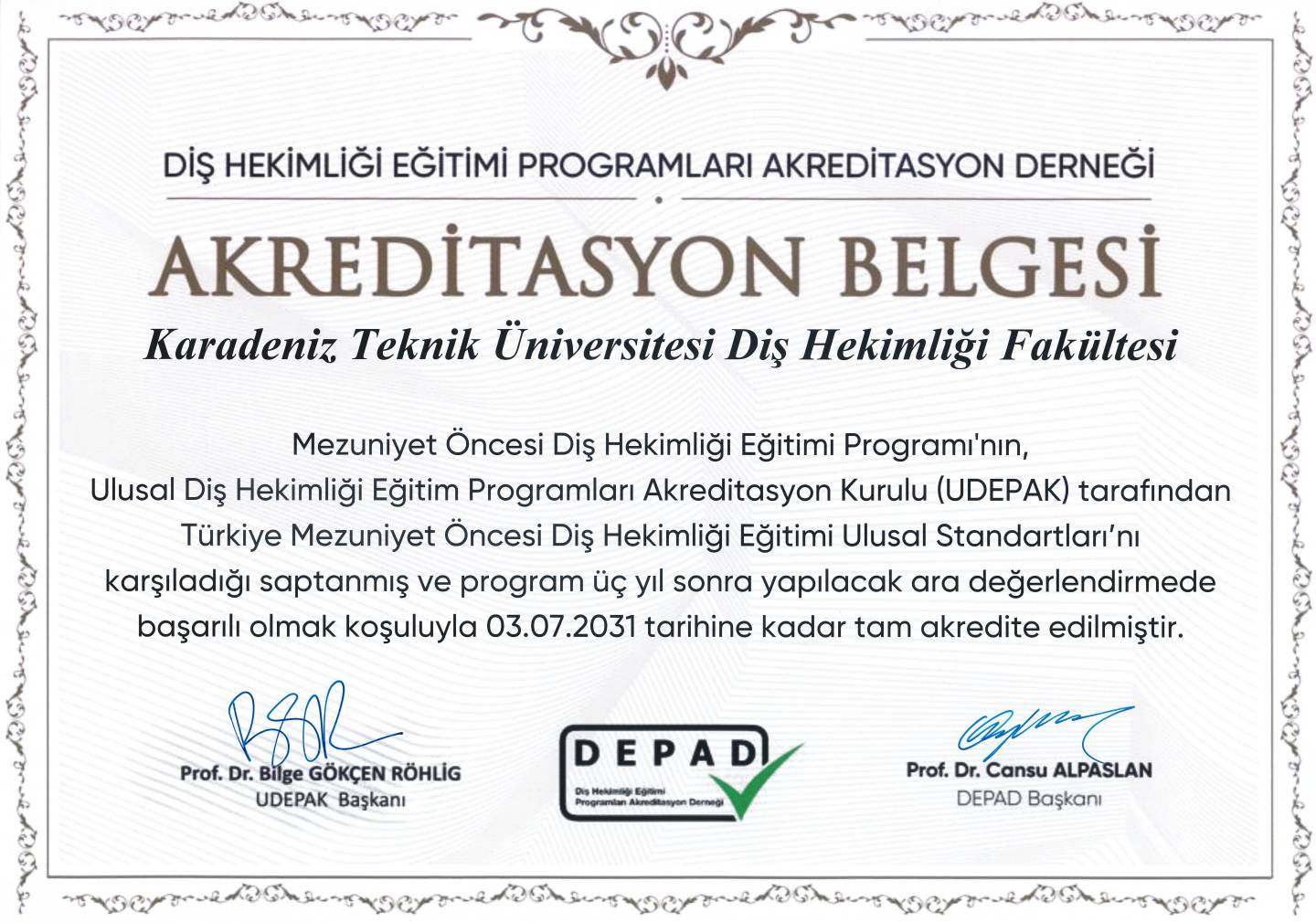
With the Decree No. 2003/5782 of the Official Gazette No. 25157 dated July 03, 2003 and numbered 25157, our Faculty, which was decided to be established by the Council of Ministers on 17.06.2003 in accordance with the additional article 30 of the Law No. 2809 dated 28.03.1983 and dated 28.03.1983, upon the letter of the Ministry of National Education dated June 09, 2003 and numbered 14407, affiliated to the Rectorate of Karadeniz Technical University, started education in the 2006-2007 Academic Year as of 25.09.2006. Since its establishment, 867 dentists have graduated from our Faculty, including the graduates of the 2022-2023 academic year, while 582 students are still actively continuing their education.
In the light of the most advanced methods and techniques, our faculty trains responsible dentists, specialists and academicians who can provide the oral health needs of the people of our country, are open to innovations, respect professional ethics and patient rights.
There are 126 dental units in the clinics of our faculty. There is also 1 Research Laboratory, Phantom Laboratory with a capacity of 50 people and 4 classrooms. In the 4th and 5th grades, our students complete their internships by performing all kinds of dental treatment procedures in our modern clinics with modern equipment in the presence of faculty members.
Our Success and Difference; Our faculty provides all the conditions required by modern dentistry education. The students of our faculty are trained in the phantom laboratory with simultaneous demo imaging system, which is the first in our country in educational services. Dental tomography and digital radiography units, CAD-CAM system that enables aesthetic porcelain restorations (laminated, crown, bridge, filling) in a few hours, laser clinic with hard and soft tissue laser devices, micro-endodontics clinic where endodontic treatments are performed under a microscope and dental treatment applications under sedation / general anaesthesia make us compatible with international standards.
Another activity required by our mission is to provide quality oral and dental health services to the society. In addition to routine patient treatments in our faculty, dental treatment procedures are carried out under general anaesthesia in Farabi Hospital operating theatres, especially for disabled children and adults and children with dentist phobia, and we are responsible for being one of the centres that can provide this service in our region. In addition, the operations of patients requiring jaw surgery under general anaesthesia are performed jointly with Kanuni Training and Research Hospital within the framework of the protocol. Scientific research-projects and publications, which is another of our duties, continue.
Number of Students: As of the end of the 2022-2023 academic year; 867 dentists graduated from our faculty. Currently, 582 students at the undergraduate level and 95 students at the speciality level continue their education.
Department of Oral and Maxillofacial Radiology
Department of Oral and Maxillofacial Radiology is the department where patients are examined when they first apply to the faculty. In these two separate clinics, which work as Oral and Maxillofacial clinic and Radiology clinic, dental caries, gingival diseases, some changes that other diseases can cause in the mouth and the diagnosis of diseases occurring in the mouth and jaws are dealt with. In the diagnosis and treatment of these diseases, imaging is usually required and these imaging methods and also the radiography needs of other clinics are met in our Radiology clinic, and when necessary, medical medicine branches are used for advanced imaging and examinations. As a result of these procedures, the planned treatments of the patients are carried out by other relevant clinics of our faculty.
Department of Oral and Maxillofacial Surgery
The Department of Oral and Maxillofacial Surgery is the branch of science where operations related to the maxillofacial region such as normal and surgical extractions of teeth, embedded tooth operations, implant placement, operations and reconstruction of jaw cysts and tumours, preprosthetic surgery operations, surgical treatment of maxillofacial fractures, orthognathic surgery operations and jaw joint operations are performed.
Department of Endodontics
Endodontics is the branch of dentistry that deals with the morphology, physiology and pathology of the human tooth and in particular the tissues surrounding the pulp (tooth pulp), tooth root and root tip. The field of endodontics includes the biology of the dental pulp, tooth root and tissues surrounding the root, and the etiology, diagnosis and treatment of diseases and injuries affecting these tissues. In the endodontic clinic, treatment of pulp and periapical pain, vital pulp treatments such as pulp coating and amputation, root canal treatment, surgical removal of pulp-derived pathological tissues, replantation of avulsed teeth and conscious replantation procedures, endodontic implants, bleaching of discolored tooth enamel and dentin tissues, and post and/or core restoration associated with coronal restorations involving the root canal cavity. The Department of Endodontics provides undergraduate education, scientific research, and patient treatment services.
Department of Orthodontics
Orthodontics means "straight teeth" in Latin. In general, it is a branch of dentistry that deals with the diagnosis, treatment and prevention of disorders in the teeth and jaw structures of children and adults. These procedures are performed by people who have received special training in the field of orthodontics and are defined as "orthodontists". The orthodontist corrects the bad positions of the teeth and jaws with the help of various devices and wires prepared for orthodontic treatment. The main goals of the orthodontist are to provide the patient with a beautiful facial aesthetics and an impressive smile, and to achieve the tooth and jaw relationship necessary for healthy chewing and speech.
Importance of Orthodontic Treatment
With orthodontic treatment, the teeth are properly placed on the jawbone, while the pain reflected in the jaw joint, head, neck or other organs caused by bite disorders disappears. By giving the person a good chewing function, problems related to the digestive system, especially stomach problems, can be eliminated. In order to speak well and make sounds correctly, it is necessary to have a regular tooth-jaw relationship. It is not possible to fully clean teeth that are out of position (forward-backward or sideways). Teeth that cannot be cleaned completely are candidates for caries. Orthodontics allows you to take better care of your teeth while aligning them properly, thus reducing the risk of caries.
What is the age for orthodontic treatment?
Orthodontic treatment can be applied to both children and adults as long as the teeth are healthy. However, since some problems are easier to solve during the growth and development period, it is recommended that children undergo orthodontic examination from the age of 7. Some orthodontic problems are easier to treat in the early period. For this reason, waiting for all permanent teeth to erupt or for growth to end sometimes makes treatment difficult. Developing technology makes orthodontic treatment that cannot be done in childhood possible in adulthood. In fact, treatments involving the teeth can be performed at almost any age; as long as the teeth and gums are healthy. However, anomalies involving the jaw bones can only be corrected by surgery at an advanced age. Duration of Orthodontic Treatment In general, active treatment with orthodontic appliances lasts 1-3 years. However, this period depends on the patient's growth and development period, the degree of malocclusion, the patient's oral care, compliance with the treatment and the doctor's recommendations and appointment dates. Non-severe disorders can be treated in a shorter period of time and some individuals respond to orthodontic treatment in a shorter period of time.
Department of Pediatric Dentistry
The branch of dentistry that performs all kinds of treatment and preventive dentistry procedures applied to children is called pedodontics.
Pedodontics covers paediatric dental treatments except orthodontics. Child treatment requires special attention. It is necessary to know the psychology of children well, to get them used to the dentist's chair without scaring them and to inform them about dental hygiene so that they can live with healthy teeth throughout their lives.
Department of Periodontology
Periodontology is the branch of science that examines the gingiva and the supporting tissues surrounding the tooth.
The treatment scope of periodontology includes oral hygiene motivation, scaling, gingivitis, gingival overgrowth, combined treatment of tooth and gingivitis, early and late periodontal diseases, gingival recession, treatment of tooth mobility due to periodontal disease, and implant placement into the jawbone.
Department of Restorative Dentistry
The shape, position or colour defects of the teeth are important in terms of aesthetics as well as function and phonation. Teeth, which form an important part of our face when we smile, have a very important share in having a beautiful appearance. Our main goal is to raise awareness of the society about dental health, which has an impact on general health as well as aesthetic value, to guide the society, to apply the necessary treatments and thus to increase the quality of life of the society. The applications in our clinic include preventive and preventive treatments against oral and dental diseases, as well as aesthetic and restorative applications in which the structure and deformities of the teeth due to caries, trauma, discolouration and various anomalies are rearranged with restorative materials.
Department of Prosthodontics
Prosthesis means the artificial replacement of any deficiency in the body or any organ or tissue that cannot fully fulfil its function. Prosthodontics in Dentistry means the artificial replacement of missing or lost teeth with new ones. Depending on the number of missing teeth, their location and the condition of the surrounding tissues, treatment can be performed with fixed restorations, partial dentures and complete dentures. With the development of implantology, we can make prostheses supported by implants. Deficiencies or deformities in the jaw, tongue and facial areas can often be treated prosthetically. Occlusal rehabilitation and orientation of treatment in temporomandibular joint disorders are among the tasks of prosthodontics. The aim of all our restorations is to fulfil the function, phonation and aesthetics that the patient has lost or is missing.
Number of Academic Staff
|
|
|
|
|
|
|
|
|
Clinical Departments |
Proffesors |
Associated Professors |
Assistant Professors |
Specialist |
Research Asistant |
Total |
|
Oral and Maxillofacial Radiology |
1 |
0 |
1 |
5 |
- |
7 |
|
Oral and Maxillofacial Surgery |
2 |
2 |
0 |
16 |
- |
20 |
|
Endodontics |
1 |
1 |
2 |
13 |
- |
17 |
|
Orthodontics |
- |
- |
3 |
18 |
1 |
22 |
|
Pediatric Dentistry |
2 |
1 |
1 |
17 |
- |
21 |
|
Periodontology |
1 |
- |
1 |
13 |
- |
15 |
|
Restorative Dentistry |
- |
2 |
1 |
9 |
1 |
13 |
|
Prosthodontics |
3 |
1 |
- |
17 |
- |
21 |
|
Total |
10 |
7 |
9 |
108 |
2 |
136 |
Phantom Labaratory:
Today, dental education benefits from new opportunities provided by technology in addition to traditional methods. These technologies help dental students put their theoretical knowledge into practice and improve their clinical skills. It is a laboratory consisting of phantom head models made of materials that resemble real human jaws and teeth and do not pose a risk of harm to our students. Thanks to the phantom model in front of the educator and a camera looking at the model from above, students can follow the procedures applied by the educator on the phantom model on the monitors in front of them and apply prosthetic, restorative and endodontic procedures using aerators and micromotors on their own phantom models. In addition, a periapical radiograph compartment, which is the first in Turkey, has been established in the phantom laboratory of our faculty. Thus, our students were introduced to the use of X-rays in endodontic applications at an early stage.
Preclinical Laboratory:
Practical education in dentistry education consists of interconnected pre-clinical and clinical applications. In our faculty, pre-clinical education is given in the theoretical part with "manipulation" and "prosthetic dental treatment" aiming to learn dental morphology and develop manual skills, while in the practical part, in the Preclinical Laboratory; it is ensured that the learned morphology is applied on materials such as soap, plaster, wax. In addition, prosthetic preparations and fixed, total and partial prosthesis applications are performed on phantom teeth and jaws. In this way, our students can better prepare for the difficulties they may encounter during clinical practice by experiencing dentistry practices in a realistic environment.
CAD-CAM and Laser Applications:
Advanced technologies in dentistry help to make dental education more attractive and up-to-date. By observing these technologies, dental students are expected to grow up as more prepared dentists with the widespread use of these technologies in the future.
Clinical Observation:
Pre-clinical basic skills are the skills that should be acquired by students before they begin actual patient treatment in the clinic. These skills are necessary for students to be able to work safely and effectively in the clinical work environment. Core skills, which are directly related to the clinical work environment, cover the basic skills necessary for students to work safely in the clinical environment. These skills include cross infection control, hand washing, dealing with emergencies and preparing the clinical environment. Skills that are indirectly related to patient care are the ability to communicate effectively with patients and to work in a team. Communication skill refers to the ability to understand patients' needs and provide them with the right information and treatments. Teamwork skill is the ability to work together with other healthcare professionals and collaborate to achieve common goals. Our 3rd year students increase patient safety and their future professional success with all these gains before starting clinical practice.
Clinical Practice:
Clinical competence is a complex concept that requires the combined use of cognitive and motor skills. Cognitive skills include mental processes such as understanding and interpreting information, problem solving and critical thinking. These skills are necessary in the clinical setting in situations such as correctly understanding the needs of patients, developing accurate diagnosis and treatment plans, and providing information and support to patients. Motor skills include skills such as coordinating physical movements, ensuring hand-eye coordination, and developing motor skills. These skills are necessary in situations such as intervening with patients in the clinical environment, performing surgical procedures, and performing dental practices. Learning in the clinical environment allows students to develop both cognitive and motor skills. In accordance with these mottoes, our faculty's 4th and 5th year students can reach clinical competence by developing their cognitive and motor skills as they gain experience in the clinical environment.
Our graduates can work in private practices, centres and hospitals affiliated to the Ministry of Health, Faculties of Dentistry and R&D Centres. Those who want to become a specialist dentist can take the "Dentistry Speciality Education Entrance Examination (DUS)" conducted by ÖSYM and receive speciality education in the speciality field of their choice.
18 July 2024