Our University systematically monitors women’s access to higher education across the stages of application, placement/admission, and enrolment through institutional data systems and national higher education data infrastructures. This monitoring is not limited to determining the total number of students; rather, it is based on disaggregating data by variables such as gender, academic unit, programme, and student status, reporting these data annually, and using them in institutional planning processes.
On our University’s institutional sustainability webpage entitled “Measurement of Access Monitoring”, it is explicitly stated that statistical data relating to students are monitored regularly, reliably, and transparently. Accordingly, students’ gender distribution, programmes of enrolment, international student status, country-based diversity, disability status, and other demographic characteristics are monitored through institutional data systems. While the KTÜ Data System enables such information to be stored in an up-to-date, accessible, and analysable format, YÖK Atlas provides data on programme quotas, occupancy rates, preferences, and placement indicators, while YÖKSİS standardises the reporting of student characteristics such as gender, nationality, department, and faculty.
Evidence:
https://www.ktu.edu.tr/surdurulebilirlik/erisim-takibinin-olculmesi
This systematic approach is further institutionally secured through our University’s Policy on Women’s Applications and Admission. The policy explicitly covers prospective female students and aims to ensure equal opportunities for women throughout application, admission, entry, and participation processes. The policy defines the transparent publication of application and selection criteria and the implementation of procedures in a traceable and auditable manner as fundamental principles. More importantly, the Department of Student Affairs is assigned responsibility for collecting and reporting the necessary data relating to application, enrolment, and graduation processes. The Department of Strategy Development is responsible for establishing monitoring and evaluation systems, analysing the relevant data, and reporting the results in annual activity reports.
Evidence:
https://www.ktu.edu.tr/dosyalar/surdurulebilirlik_Ci50T.pdf
The policy also clearly demonstrates that monitoring is not a one-off activity, but rather a regular and recurring institutional process. It stipulates the establishment of a baseline inventory for female students and prospective female students, the use of these data in setting measurable targets, and the monitoring of implemented practices through performance indicators. In the “Monitoring and Reporting” section of the policy, it is stipulated that indicators are evaluated regularly on an annual basis, that annual data are incorporated into sustainability reports within six months following the end of the relevant year, and that changes are monitored over time.
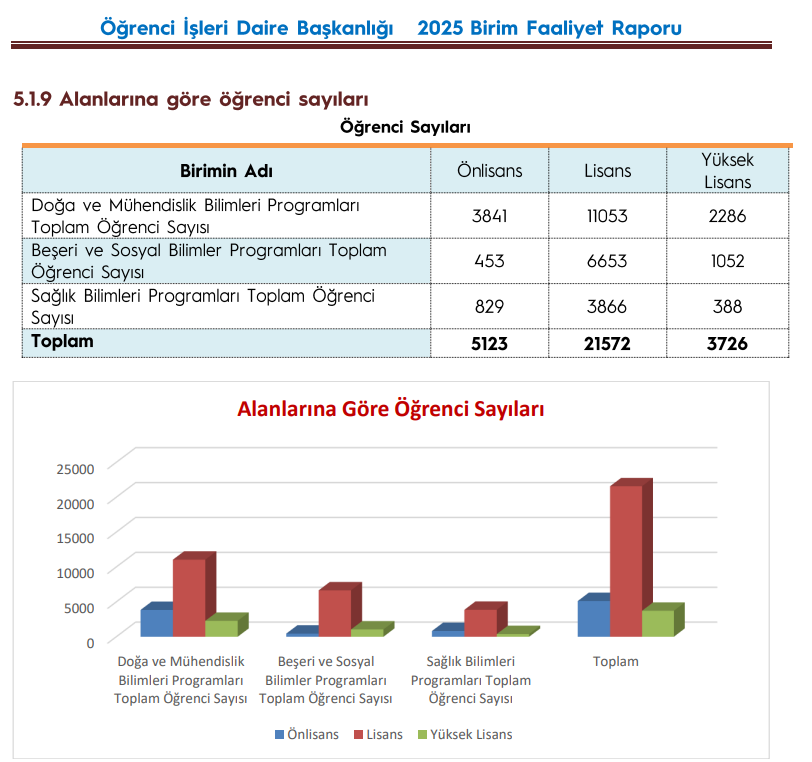
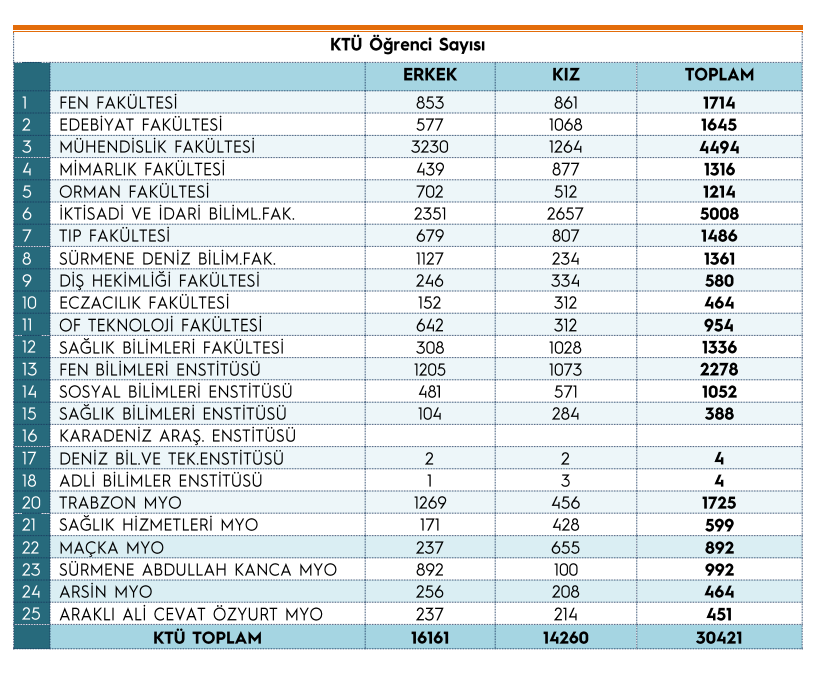
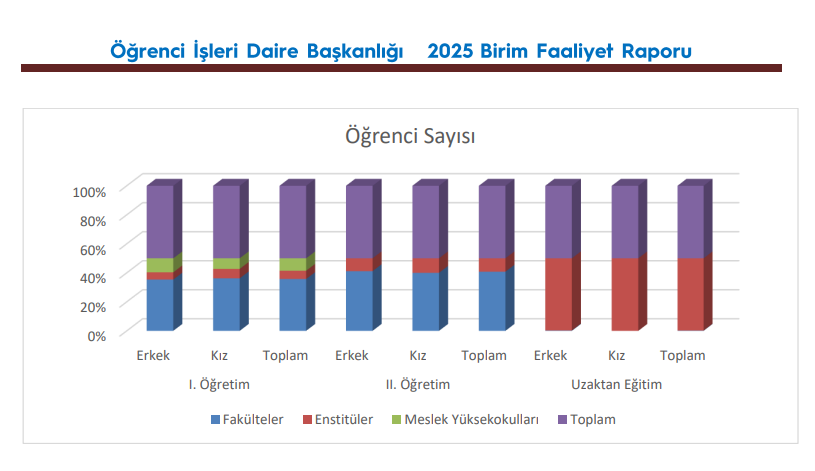
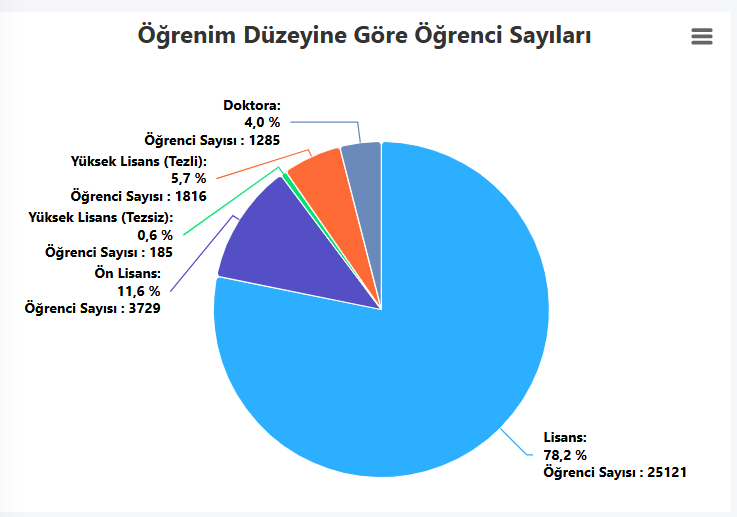
Data for 2025 demonstrate that this mechanism is also operational in practice. According to the 2025 Unit Activity Report of the Department of Student Affairs, our University had a total of 30,421 students, of whom 14,260 were women. Women therefore accounted for approximately 46.88% of the total student population. The same report also presents student numbers separately by gender at faculty, institute, and vocational school level. For example, there were 807 female students in the Faculty of Medicine, 1,028 in the Faculty of Health Sciences, 312 in the Faculty of Pharmacy, and 1,264 in the Faculty of Engineering. This disaggregation demonstrates that the representation of women is monitored not only at the institutional level, but also across different academic disciplines.
Evidence:
https://www.ktu.edu.tr/dosyalar/oidb_cv1Na.pdf
The same 2025 activity report also separately monitors the YKS quota–placement–enrolment chain. In 2025, the total YKS quota was 4,453, the number of students placed through YKS, including additional placements, was 4,618, and the number of students who completed enrolment was 4,416, resulting in an overall occupancy rate of 99.17%. Thus, placement and actual enrolment following the application/preference stage are monitored as separate indicators.
Evidence:
https://yokatlas.yok.gov.tr/detay/106210283
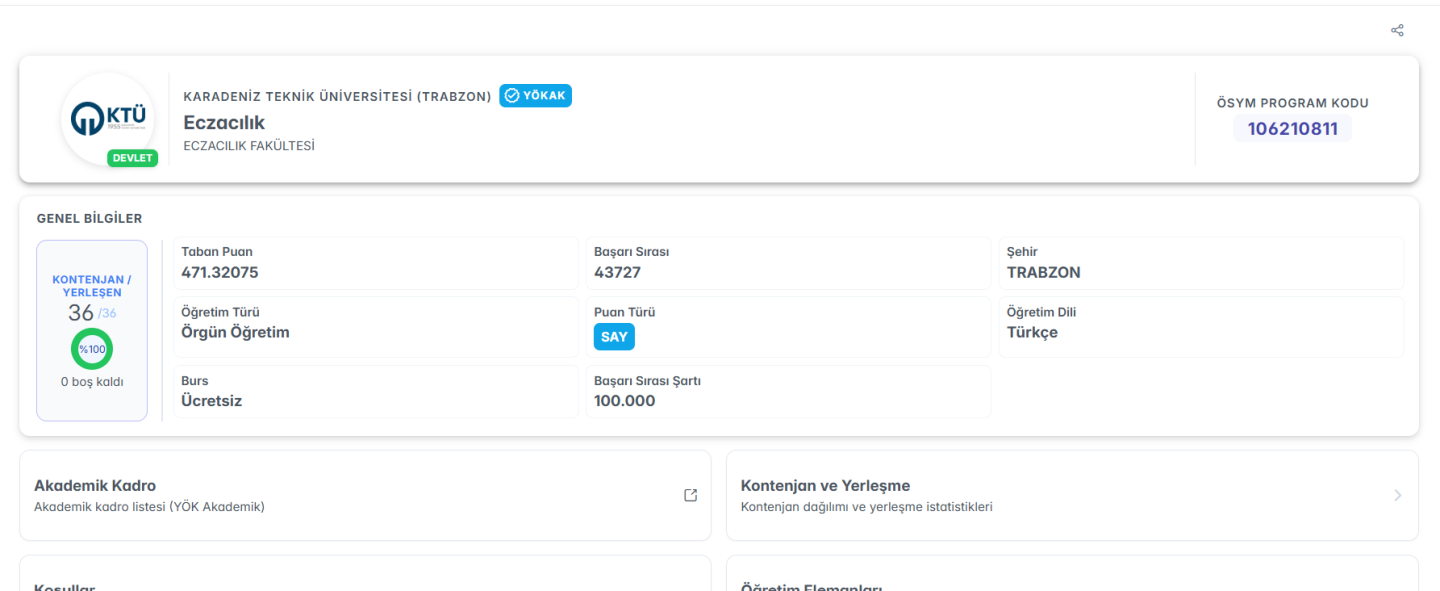
Another important data source for monitoring entry and placement by gender is YÖK Atlas. In addition to “Quota, Placement and Enrolment Statistics” for KTÜ programmes, YÖK Atlas includes a specific indicator entitled “Gender Distribution of Placed Students”. These data can be reviewed by programme and by year, including 2025 YKS data. This makes it possible to compare the proportion of female students placed in different academic programmes.
This approach is also implemented at the level of academic units within our University. For example, the Faculty of Economics and Administrative Sciences published student enrolment statistics for the 2025–2026 academic year, including students admitted through YKS, DGS, central and inter-institutional transfer, international student admission, double major/minor programmes, and Erasmus, with the figures presented by department and gender. This practice demonstrates that female students entering the University through different access routes can also be disaggregated and monitored at academic unit level.
With regard to application processes, our University is not solely dependent on centralised placement mechanisms such as YKS. In 2025, international student applications were received directly through the University’s online system, with the application, placement, and enrolment stages administered separately. Similarly, applications and final enrolment procedures for postgraduate programmes were conducted through the central KTÜ online application system. This electronic infrastructure enables applicants, successful/accepted candidates, and enrolled students to be monitored and compared systematically across the different stages of access to the University.